
The Grand Tour of Antiquity: A Photo Gallery
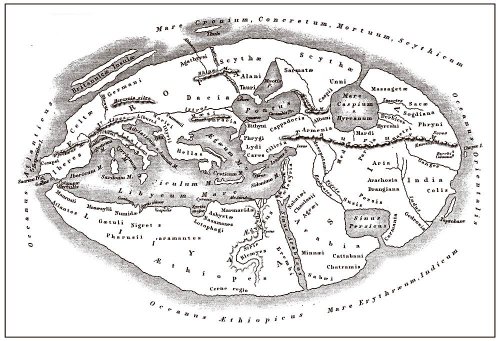
Rome
Imperial Rome was the New York of its day—a vast, gangling, bloated organism, teetering on the verge of complete logistical collapse, far and away the largest concentration of humanity the world had ever seen. With over one million inhabitants by the end of the first century AD, it was ten times the size of classical Athens, and immeasurably more spectacular. Living in this teeming city, the self-ordained Capital of the World, was hopelessly addictive: For the intrepid Romans about to leave on their Grand Tours, a journey that would take them away for years, the prospect of departure was bittersweet.
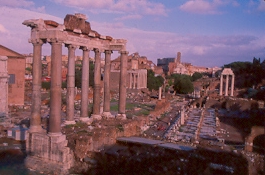
View of the Forum Romanum from the Capitoline Hill. This was the ancient site of Rome's most sacred temple, dedicated to Jupiter Optimus Maximus, the King of the Gods. Roman travelers would come here to gaze over their beloved city for one last time and make promises to Jupiter in return for a safe journey.
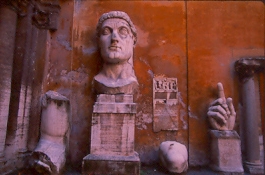
Fragments of a statue of the Emperor Constantine on display at the Museo del Campidoglio (which occupies the site of the temple to Jupiter). Only a fraction of the fabulous imperial city survives today; the ancient streets are buried under thirty feet of debris.
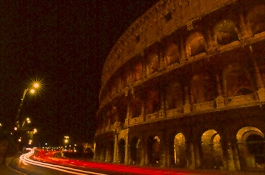
The Colosseum, site of imperial gladiatorial shows. These extravaganzas, which often involved elaborate props, music and scenery, were the Cats and Les Mis of their day, luring thousands of wide-eyed provincials to Rome.
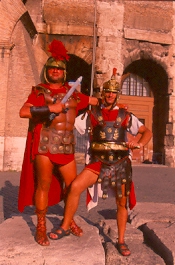
Centurions pose for tourists in front of the Colosseum today, wearing outfits left over from the popular sword-and-sandal epics filmed in Italy.
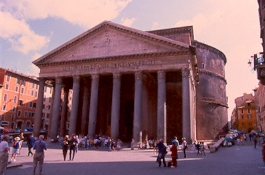
The Pantheon, or temple to all the gods—the only intact pagan temple to have survived from ancient times (the others were all destroyed by Christians during the Middle Ages, their masonry cannibalized to build cathedrals). In the imperial era, the interior of its dome was covered with silver and lined with dozens of gilded statues.
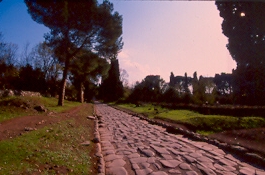
The Appian Way—Queen of Highways—Rome's route to the East. In ancient times, it was lined with tombs and mausoleums, with striking inscriptions for travelers to read: I ADVISE YOU TO ENJOY LIFE MORE THAN I DID! proclaimed one.
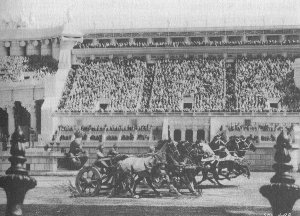
Chariot race in the Circus Maximus, from the 1926 silent film, Ben-Hur.
Southern Italy
If Rome was the New York of antiquity, the Bay of Naples was the Hamptons. Every summer, the wealthy of the capital traveled to the craggy,sun-drenched shores, where they could relax in their luxury villas and enjoy the pleasures of the world's first seaside resorts. On hot Italian nights, the hills of the bay would echo with the sound of drunken carousing, as revelers jaunted from one beach to the next, quaffing fresh oysters at nude swimming parties. The town of Baiae became famous for truly Herculean debauchery, with prostitutes sailing off-shore in barges, garlanding the waves with rose petals and competing with one another in singing competitions. "Unmarried women are common property," complained one straight-laced visitor. "Old men behave like young boys, and a lot of young boys like young girls."
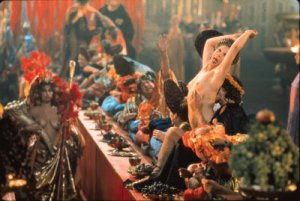
A modern interpretation of party time by the Bay of Naples, from the 1980 film Caligula.
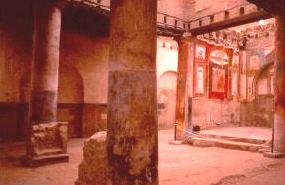
An excavated holiday villa in Herculaneum, buried along with Pompeii in the eruption of Vesuvio in AD 79. Wealthy Romans competed with one another in displays of extravagance, building pools filled with fish, elaborate gardens and private aqueducts.
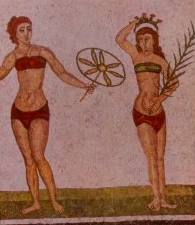
Roman beach culture: Ancient nymphets sport prototype bikinis in a fresco from a villa in Sicily.
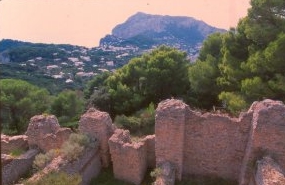
The ruins of the Villa Jovis on the island of Capri—the supposed "den of lechery" of the Emperor Tiberius, who retired here for fifteen years (it was rumored that he had teams of sprintriae, "adepts at unnatural practices," to rouse his flagging passions).
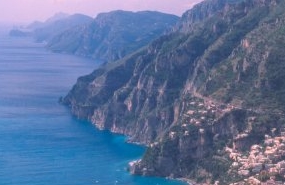
The Amalfi Coast, once dotted with Roman luxury villas (the view is from Il Sentiero degli Dei, the Trail of the Gods—an ancient hiking route high in the mountains).
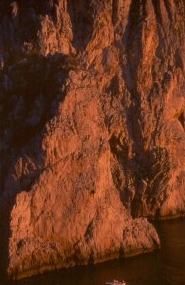
Spectacular cliffs of Capri. Tiberius was said to torture his victims at his villa, then fling them to their deaths down these precipices.
Greece
For cultivated Romans, Greece was the ultimate culture trip—an unforgettable vision of the Old World, sprinkled with olive groves and bathed in summer light. As the very wellspring of civilization, every inch of Hellenic soil was steeped in history and myth: Ancient tourists sought out the hallowed glades where the Gods had romped and legendary heroes, from Hercules to Ulysses and Agamamnon, once fought. The dry, craggy mountains above were riddled with sacred grottoes, the playgrounds of nymphs and sprites; Greek temples were full of wondrous relics; while Arcadian villages still practiced religious rites that could be traced back to the Homeric age. Today, Greece's allure is still potent. In fact, Roman travelers would have sympathized with the author Henry Miller who visited in 1939: "Greece is what everybody knows," he raved. "Even as a child or an idiot or a not-yet-born. It breathes, it beckons, it answers."
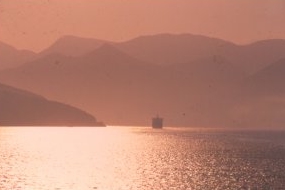
Modern ferries still ply the ancient merchant route from Brindisi in Italy through Greece's Gulf of Corinth.
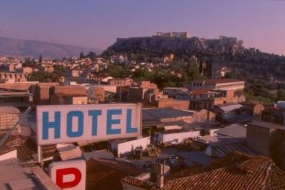
View from a hotel rooftop in Athens to the Acropolis. For the Romans, this sacred summit was one of the great "must-sees" of the entire Empire; in ancient times, it was crowded with statues, shrines and temples, including a giant statue of the goddess Athena, whose polished bronze spear and helmet sparkled in the Aegean sun.
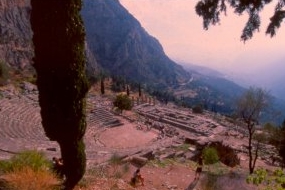
Ethereal Delphi: the shape of the classical Greek amphitheater blends with the natural arena. In the Temple of Apollo, a priestess would inhale sacred gasses and babble oracular prophecies. The popular site was also one of the great tourist traps of antiquity: Mystagogi, freelance tour guides, would harass tourists from every side, prattling their spiels, while visitors tried to concentrate on the sculptures and paintings.
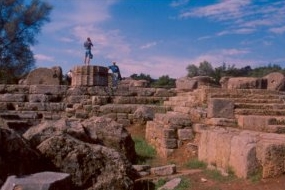
Remnants of the Temple of Zeus at Olympia, where the sacred Olympic Games were held every four years. The event would lure 40,000 spectators from around the Mediterranean, who would camp out around the temple in conditions as unsanitary as a badly planned rock concert today. See The Naked Olympics: the True Story of the Ancient Games.
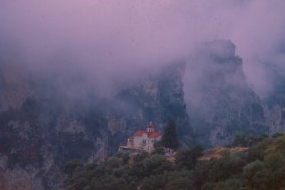
Mist drifts through the Lousios Gorge in Arcadia. This wild and remote part of Greece was the mythic prototype for the earthly paradise, haunted by the god Pan and his sprites. These original Arcadians of Greek myth were lusty primitives, dressed in goatskins and lashed by rains (Pan himself apparently masturbated constantly); it was Roman poets who civilized the image, creating a tamer vision of Arcadia as a gentle, manicured garden.
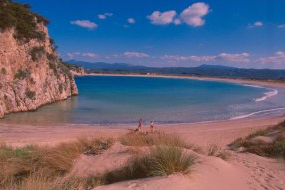
One of the last undeveloped beaches in Greece still lies on the west coast of the Peloponnesus, near "sandy Pylos"—in Homer, ruled over by the wise King Nestor.
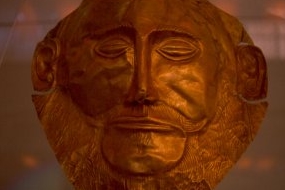
The so-called "Mask of Agamemnon," unearthed by the archaeologist Heinrich Schliemann at Mycenae in 1876. Schliemann used the second century AD tourist guide, Description of Greece—written by a dotty scholar named Pausanias for erudite Roman tourists—as his key to exploring the forgotten site.
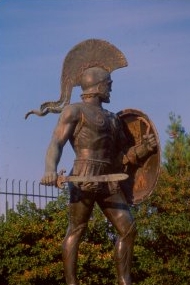
Statue of King Leonidas, the hero of Thermopolyae, in Sparta today. Roman tourists loved to visit "warlike Sparta" for its macho rituals—including one brutal festival where youths were driven through the streets by men with sticks and whips, rather like the annual "running of the bulls" in modern Pamplona.
Aegean
The sun-bathed outposts of the Greek islands may now be invaded every summer by northern European tourists, but the culture-loving Romans were uninterested in the empty Aegean beaches, inhabited as they were only by illiterate goatherds and fishermen. The lonely sands of the islands merely reminded them of the grave. Instead, the first tourists sailed on merchant ships from Piraeus—generally sleeping on deck, gazing up at the stars while sipping a glass of Falernian wine—to make landfall at the islands of Delos and Rhodes, which were full of mythic associations. At Rhodes, they could still admire the remains of the famed Colossus, the giant metal statue that had fallen to earth during an earthquake. (Pliny the Elder reports climbing inside the shattered giant, broken at the knees, which he still regarded as one of the Wonders of the World).
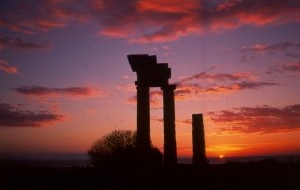
When the orator Lucian visited in the second century. Like at mainland sites, he was exasperated by the persistent mystagogi, or guides ("those who show the sacred places to foreigners.") "Abolish lies from Greece," he railed, "and the guides would die of starvation, since nobody wants to hear the truth, even for free."
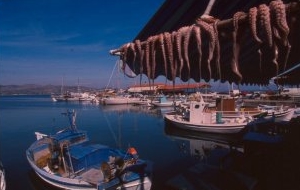
Squid drying at a fishing village on Rhodes. The only surviving Roman cookbook, by Apicius, includes a recipe for seafood stew—an incipient bouillabaisse.
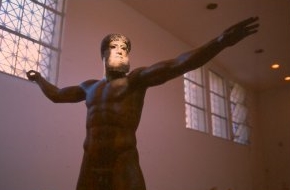
A bronze statue of Poseidon, god of the sea. His fickle moods were a source of constant worry to ancient sailors, who offered regular sacrifices to him on their trips.
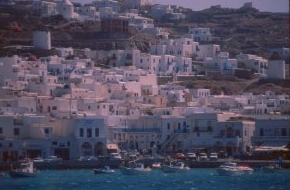
The harbor at Mykonos, jumping-off point for Delos.
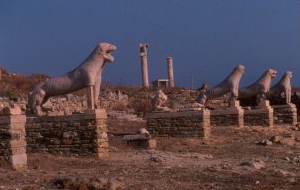
The famous avenue of lions on the island of Delos, birthplace of the god Apollo. By the time ancient tourists were visiting, in the first century AD, this once-thriving Greek trading outpost had been all but abandoned. Even so, a hallowed shrine to Apollo was still thriving and luring pagan pilgrims (priests even showed off the tree that the goddess Leto had grasped while giving birth to the deity).
Turkey (Asia Minor)
Turkey—the Roman province of Asia Minor—was the perfect place for ancient tourists to relax from the rigors of travel. The coast was populated by sophisticated Greeks, and dotted with regal cities like Ephesus and health spas like Pergamum, which were far wealthier and more glamorous than Athens. Romans would unwind in magnificent bath houses, take in the gladiatorial shows at sumptuous amphitheaters, and enjoy invitations to magnificent banquets—with every pleasure raised to an Oriental peak of luxury. Today, Turkey is still a vacationer's paradise, while the ruins along its coastline are actually more impressive and better-preserved than most sites in Greece.
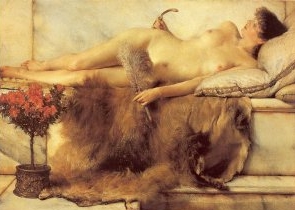
Tepidarium (1881), by Sir Lawrence Alma-Tadema; a Roman woman unwinds, evidently drained, after a steam bath.
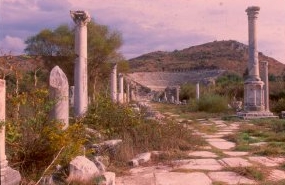
Ephesus is one of the great historical sites of the Mediterranean—an entirely preserved Roman port, complete with splendid highways, arenas and mansions. As one of the Empire's wealthiest cities, it is much more impressive than Pompeii: Strolling its grand boulevards, you can almost hear and smell the ancients at work and play.
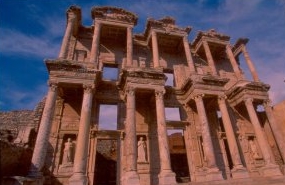
The Library of Celsus in Ephesus, one of the most perfectly restored of all ancient buildings.
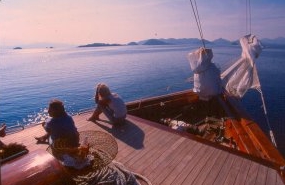
A gulet, a wooden-hulled Turkish yacht, cruises the coast of Lycia, now known as the Turquoise Coast. A Blue Cruise around this pristine stretch of Turkey allows travelers to glimps the Mediterranean as it may have looked to Homer.
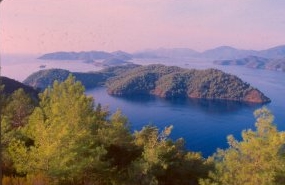
Islands in the Gulf of Gocek—where Daedelus and Icarus took off for their fateful flight.
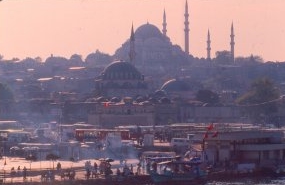
Istanbul seen from the Golden Horn. One of the world's great cities was built on the site of a scrappy and modest Greek port known as Byzantium. Roman tourists would occasionally come here to catch merchant ships heading south.
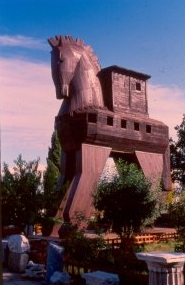
A re-creation of the Trojan Horse, by the ruins of Troy. Under the Empire, patriotic Romans flocked here on "roots" tours, to see the great sites mentioned by Homer. For a fee, the Trojans led visitors to counterfeit sites like the tomb of the mighty Achilles, where they could sacrifice, and temples supposedly housing the comb of Helen and lyre of Paris, the whole time reciting key passages from the Iliad. Occasionally, the giant bones of ancient warriors would be unearthed—actually dinosaur bones—and placed reverentially for inspection by awed tourists. Few could resist such magical offerings. The Emperor Hadrian himself even traveled here to re-bury the skeleton of the hero Ajax.
Egypt
For any ancient Roman traveler, Egypt was the climax of the Grand Tour. This mysterious land was a true sightseer's paradise: It offered overpowering ruins of unspeakable age, a religion full of ghoulish mummies and jackal-headed gods, and an exotic living culture—the same elements that have hypnotized travelers ever since. Egypt is also the section of the ancient tourist trail that is easiest to physically trace. Modern travelers still follow the same logical itinerary along the Nile River as the Romans once did—gazing in awe at the same hieroglyphic-covered monuments within the same parched landscape.
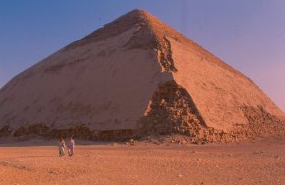
South of the Giza Plateau, the so-called Bent Pyramid at Dahshur is the only pyramid to survive with a large part of its limestone coating intact. In Roman times, the structures were all still sheathed in white stone, making them glisten like icebergs on a sea of sand. (This extra layer, covered by hieroglyphics and graffiti, was removed by Arabs in the Middle Ages for building materials in Cairo, leaving the step effect we see today).
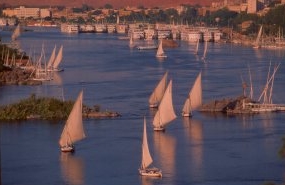
Feluccas cruising near Aswan. The Nile was considered a divine river: Its source was unknown, and it rose and fell every year without being filled with rains. Roman women traveled to Egypt just to fill vials with its water, which was sacred to the goddess Isis.
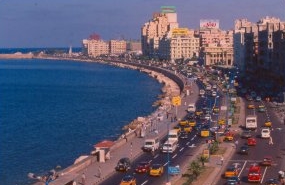
The Corniche, celebrated promenade of Alexandria and once the gateway to Roman Egypt. Arriving at Cleopatra's capital was an unforgettable experience: Ships were guided into port by the Pharos lighthouse, one of the Seven Wonders of the Ancient World. It was as tall as the Statue of Liberty and its lamps could be seen thirty miles out to sea. Life in this exotic city, where Europe met Africa and Asia, was enthralling to Roman travelers: One visitor enthused, "life in the great port was one continuous revel... of dancers, whistlers and murderers."
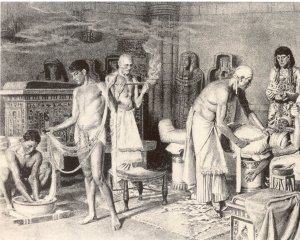
"The Embalming Shop," a nineteenth century newspaper etching showing the ancient Egyptian practice that has long obsessed Westerners. Roman tourists delighted in visiting the "mummy pits" of Memphis, where they could see corpses in various states of preservation. Mummification was still extremely popular in Egypt, even with wealthy Greek and Roman residents; Romans liked to have life-like portraits placed on their mummies, as an aid to identification in the afterlife.
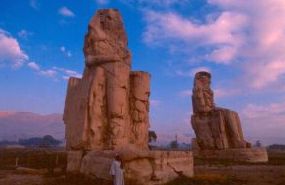
The Colossi of Memnon, which once "sang" to Roman tourists. Located outside the Necropolis of Thebes, the Colossi became the most famous sightseeing attraction in the Roman world. Air trapped inside one statue would expand and be released at sunrise every morning, creating a haunting whistle sound—which Romans became convinced was a pagan miracle, the sound of the Homeric hero Memnon greeting his mother, the Dawn.
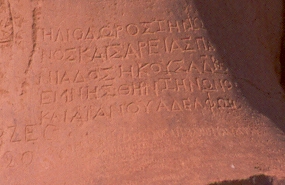
Romans loved to leave graffiti on monuments of all kinds, often hiring professional stone cutters to carve their words ("I was amazed!" was a popular favorite; "I was more than amazed!" someone wrote in the Valley of the Kings, in an example of one-upmanship). This Greek inscription is part of a lengthy poem in the Homeric style, etched into the leg of one of the Colossi of Memnon.
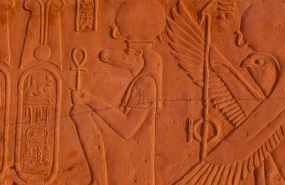
Crocodiles were worshipped up and down the Nile, as incarnations of the god Sobek. In the Fayum Oasis, the animals were kept in a private pool and hand-fed by priests for the pleasure of tourists—a forerunner of dolphin shows in Florida today.
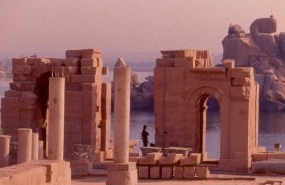
The sacred island of Philae, holy to the goddess Isis, marked the end of the Grand Tour. It was also the frontier of the Roman Empire: Only the most intrepid tourists ventured further south.
Other Editions Available:
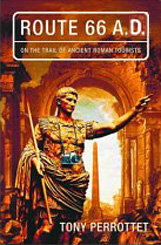
US Hardcover Edition, Now published in the US in paperback as Pagan Holiday


Also by Tony Perrottet:
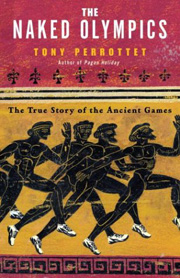
The Naked Olympics: The True Story of the Ancient Games
What was it like to attend the ancient olympic games?
As the summer Olympics return to Athens, Tony Perrottet delves into the ancient world and lets the Greek Games begin again. The acclaimed author of Pagan Holiday brings attitude, erudition and humor to the fascinating story of the original Olympic festival, tracking the event day by day to re-create the experience in all its compelling spectacle.